
Electronic signature APIs vs ready-to-use portal: Which route is best?
Electronic signatures have transformed how organisations manage documents, replacing inefficient paper-based workflows with secure, digital processes. For organisations looking to adopt these solutions, the choice often comes down to two options: integrating APIs or using ready-to-deploy portals. Each has distinct advantages, and selecting the right one depends on your organisation's technical capability, operational demands, and growth strategy.
Electronic signature APIs: Built for integration
Electronic signature APIs allow you to integrate signing functionality directly into your existing systems, providing greater control. With an API, your organisation can streamline signing processes within your current applications or workflows, eliminating the need to redirect users to third-party platforms. This solution is perfect for businesses focused on scalability and maintaining brand consistency.
APIs excel in environments needing customisation, automation, or high-volume capacity. They let teams create tailored signing experiences, integrate authentication, and build multi-step workflows. Designed for flexibility, APIs not only meet current needs but also adapt to future challenges, enabling new features and expanded functionality as your business grows.
Key API benefits
- Full control over the experience: API integrations give organisations full control over a branded signing experience, avoiding redirects and reducing friction, ensuring consistency and building trust with customers.
- Optimised workflows: APIs automate and optimise signing workflows by embedding e-signatures into existing systems, making approvals, multi-signer tasks, and custom forms faster and error-free.
- Effortless high-transaction volumes: APIs handle high transaction volumes effortlessly, making them perfect for enterprises and scaling businesses. They ensure systems can grow dynamically without sacrificing performance.
- Global compliance: APIs comply with eIDAS regulations, enabling legally valid e-signatures across Europe. They support advanced and qualified signatures, ideal for high-compliance industries like finance, healthcare, and legal.
- Long-term cost efficiency: Although APIs require a higher upfront investment, the cost per transaction decreases with greater usage, offering better ROI for high-volume organisations.
Ready-to-use portals: Speed and simplicity
Ready-to-use portals provide complete signing solutions requiring no technical integration. Users access web-based interfaces or mobile applications to upload documents, add signers, and manage the entire signature process through intuitive dashboards.
The portal approach particularly benefits small to medium-sized organisations or departments requiring quick deployment without developer involvement. Features like real-time tracking, automated notifications, and secure document storage provide comprehensive signature management capabilities through user-friendly interfaces.
Portals deliver immediate, frictionless results and are well-suited to businesses seeking low-maintenance solutions for moderate operational requirements.
Key benefits of portals
- Rapid Implementation: Portals eliminate setup delays, enabling teams to start signing on day one.
- Minimal Learning Curve: Intuitive interfaces mean no technical training is needed.
- Mobile-ready: Web and app-based accessibility ensures flexibility for remote or hybrid teams.
- Pre-configured tools: Portals provide a wide array of pre-configured tools, like pre-built templates or drag-and-drop customisation, designed to simplify the e-signature process.
Determining the right approach
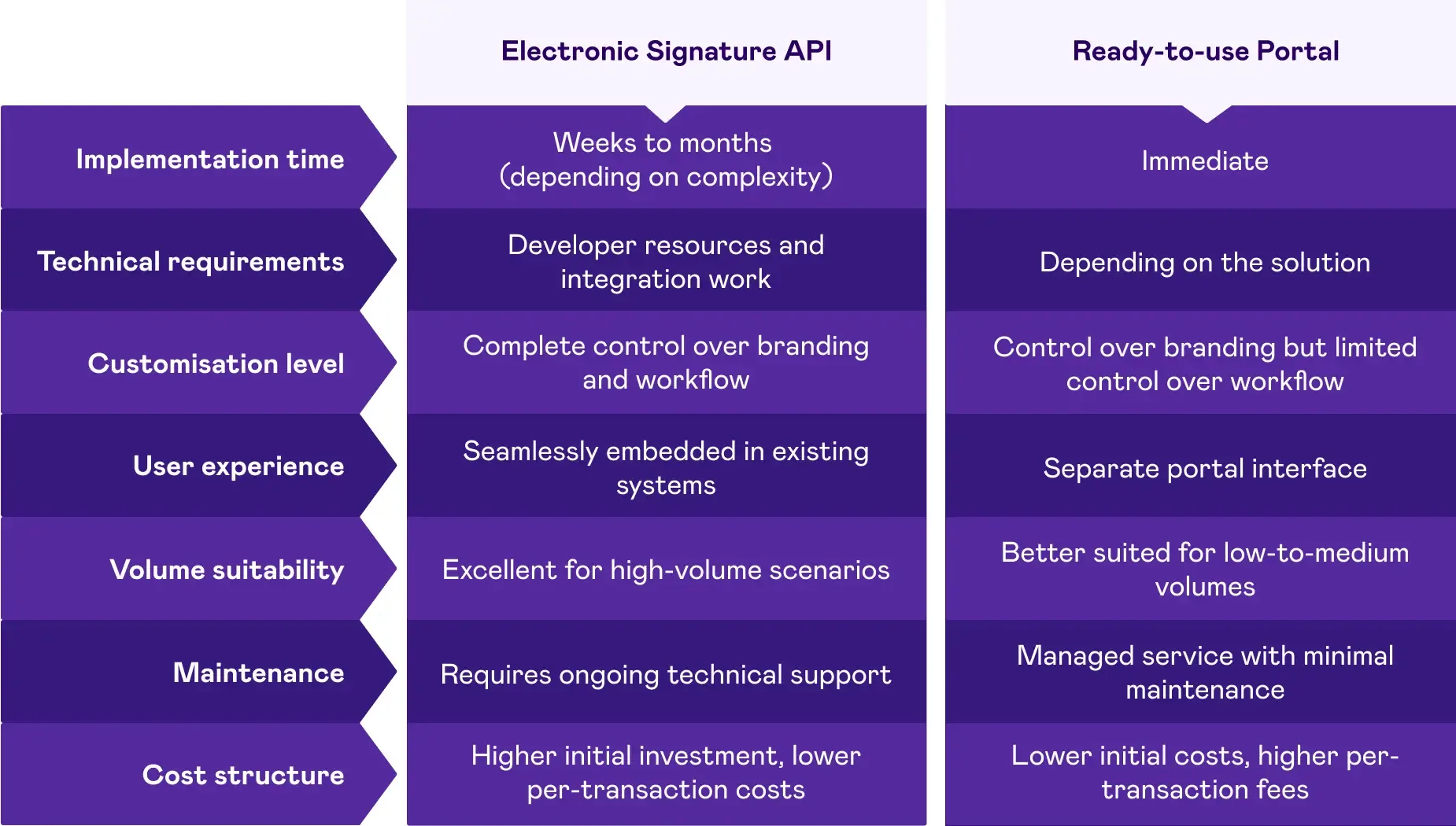
The choice between APIs and portals depends primarily on your organisation's technical capabilities, signature volumes, and strategic objectives.
Choose API integration when:
- You handle large volumes of signatures or unique use cases
- Complex workflows require custom logic and automation
- Brand consistency across user touchpoints is critical
- Long-term scalability is a primary concern
- Your organisation has development resources available
Select a ready-to-use portal when:
- Quick deployment is the priority
- Signature volumes are low to moderate, or your use cases don't require workflow customisation
- Limited technical resources are available
- Teams need immediate access to signing capabilities
- Separate signature management interface is acceptable
Hybrid approaches and strategic considerations
Many organisations benefit from hybrid implementations for different departments or use cases, using APIs for high-volume automated processes whilst maintaining portal access for ad-hoc signing needs.
Consider future growth when making your selection. Organisations anticipating rapid expansion or increasing signature volumes may prefer investing in API integration initially, despite higher upfront costs. Conversely, businesses with stable, predictable signing requirements often find portal solutions more cost-effective long-term.
Making your decision
Every second spent on manual, inefficient processes is an opportunity lost. By choosing the right electronic signature solution, your organisation can unlock higher efficiency, ensure compliance, and deliver better user experiences. Whether you’re ready to invest in APIs or seeking the simplicity of portals, Signicat offers tailored solutions to meet your needs.