From age gates to proof: Compliance reality for micromobility in 2026/2027
Europe’s micromobility rules are tightening fast, but not uniformly. As age limits, insurance and registration requirements diverge across markets, operators are being judged on what they can prove. This post outlines the key shifts heading into 2026 and why identity is becoming the most scalable compliance lever in Europe.
Europe’s micromobility sector is no longer driven by hype, pilots and scale. It has entered the age of regulation. What began with city permits and parking rules has evolved into national legislation covering age, licensing, liability, insurance, and even technical requirements for vehicles.
Yet despite tighter oversight, there is still no single European rulebook. From Helsinki to Madrid, each market is writing its own definition of a “responsible rider”. Age limits differ. Plates are mandatory in one country and irrelevant in the next. Insurance expectations and enforcement models are diverging, not converging.
Amid this fragmentation, one truth is becoming hard to ignore: identity is the only constant an operator can carry across borders.
The patchwork problem: As many realities as countries
A micromobility operator expanding across Europe is no longer just scaling a fleet. It is navigating a compliance map, and the map is changing quickly.
🇦🇹 Austria (hard line from 1 October 2026)
From 1 October 2026, “e-mopeds” (L1-eB) move onto roads and into a motor-vehicle regime with number plates, insurance, driving licence and helmet requirements. Operators will need updated routing rules and stronger post-incident traceability.
🇧🇪 Belgium (from guidance to hard controls)
Brussels has required riders to be 16+ for years, and since December 2025 shared operators have rolled out mandatory ID verification for access. High-density cities are moving from age gates to proof, and that shifts the burden of evidence towards operators.
🇩🇰 Denmark (enforcement-first baseline)
Riders must be 15+ to ride independently in traffic, and helmet use is mandatory. Identity verification helps enforce age limits and reduce account sharing and repeat offenders.
🇫🇮 Finland (safety controls are now legal controls)
Since June 2025, Finland has set a minimum riding age of 15 for e-scooter riders. Cities will expect operators to enforce this rule in real usage, not just display it in-app.
🇫🇷 France (baseline fixed, enforcement-led)
France prohibits riding under 14, bans passengers, and treats e-scooters as motor vehicles for insurance purposes, including shared rental. In practice, city contracts and insurers often set a higher bar than the legal minimum, and operators are judged on whether controls work in practice.
🇩🇪 Germany (enforcement tightening, 2027 device rules)
Germany’s age floor is 14, but enforceability is rising. The planned eKFV update gives cities more control and points to new technical requirements for new vehicles from 2027 (including indicators), increasing the need for audit-ready accountability.
🇮🇸 Iceland (a clear baseline)
Iceland sets a clear baseline with an age limit of 13 and helmet requirements for younger riders, alongside a strong stance against tampering beyond 25 km/h. Where age and safety rules are explicit, operators need checks that stand up after an incident, not just at onboarding.
🇮🇪 Ireland (clear operator requirement)
Ireland’s rules set a clear operator requirement: riders must be 16+, and shared use sits inside a defined “powered personal transporter” framework with specific use conditions. The operational implication is simple: eligibility needs to be provable when claims, complaints, or city scrutiny land.
🇮🇹 Italy (rolling implementation, ID mark detailed July 2025)
Italy is making micromobility rules enforceable. A July 2025 decree detailed the e-scooter identification mark (“targhino”) and signalled tighter expectations on insurance and helmets. For shared fleets, accountability is becoming visible, which raises expectations on traceability.
🇱🇺 Luxembourg (stricter access policies than the legal minimum)
Luxembourg’s national framework allows riding from a young age: for electric micro-vehicles, riding is allowed from age 10, with specific obligations from age 13. Operators often set stricter access policies than the legal minimum for shared schemes, which makes reliable age proof and consistent enforcement more important than the statute itself.
🇳🇱 Netherlands (licence plates from 1 July 2025, transition to 1 July 2026)
From 1 July 2025, certain light electric vehicles require licence plates and registration, with a transition for existing vehicles through 1 July 2026. Operators need identity-linked records to show who rode what, and when.
🇳🇴 Norway (two-layer reality: baseline law vs local permission)
In Norway, national road rules set the baseline, while local permits and tender terms often go further. The risk for operators is speed of change, with safety pressure driving fast shifts on age thresholds, night riding and enforcement expectations.
🇵🇹 Portugal (liability shift, in force since 20 June 2025)
From 20 June 2025, civil liability insurance is mandatory for certain motorised vehicles above defined thresholds (for example, over 25 km/h, or over 25 kg and faster than 14 km/h). Even when the legal duty sits with the rider, incidents still land on your platform and your evidence.
🇪🇸 Spain (city enforcement now, technical deadline 2027)
Spain is city-led, with many major cities operating 16+ expectations for shared schemes. From 22 January 2027, only DGT-certified VMP models can circulate (sales rules started 22 January 2024). Legacy fleets face a fixed deadline.
🇨🇭Switzerland (designed to be enforceable)
Switzerland is designed to be enforceable: riders must be 14+, and between 14 and 16 they need a category M licence. From 16, no licence is required for the standard e-scooter category (with a 20 km/h limit). Where entitlement depends on age and licensing, operators need controls that can be evidenced quickly.
🇬🇧 United Kingdom (trials extended to May 2028, scrutiny remains high)
In England, rental e-scooters still operate under trial frameworks, now extended by the Department for Transport to May 2028. Riders must hold a valid driving licence, and trial e-scooters require motor vehicle insurance. Private e-scooters remain illegal on public roads, which keeps scrutiny high and increases the value of incident-ready evidence.
🇪🇺 The rest of Europe
Across markets such as Sweden, Iceland, and much of the Central and Baltic region, the biggest swings heading into 2026 are often driven by city permitting, insurance enforcement, and scheme conditions rather than a single national reset. The operator test remains the same: can you prove, repeatedly, who the rider is, that they meet local access rules, and that you can stand behind an audit trail when something goes wrong?
There is no “European rider”. There are Finnish riders, Dutch riders, German riders, Spanish riders, each with different legal conditions attached. Operators only get scale when they can prove compliance repeatedly, in every market that matters.
Age rules are becoming proof rules
What began as a responsibility issue, preventing minors from riding, has become a legal and financial obligation.
In several markets, responsibility is shifting towards operators, enforced through licensing, city access, or insurance outcomes. That shift changes the risk profile overnight. If something goes wrong, the question is no longer “Did the rider tick a box?” It is “Did the operator take reasonable steps to know who was riding?”
Age is no longer a field. It is a liability. And a self-declared date of birth is no longer acceptable proof.
How identity verification helps operators in Europe stay compliant and scalable
- Prove eligibility: Replace self-declared dates of birth with verified age aligned to local rules and tender requirements.
- Link rides to accountability: Tie activity to a verified rider so incidents, fines and disputes can be handled with evidence.
- Cut account sharing and repeat misuse: Make it harder to lend accounts to underage riders or return after bans.
- Support insurance outcomes: Strengthen rider attribution when claims depend on who was riding and whether they were eligible.
- Enable step-up controls: Apply stronger checks when risk rises, such as new devices, unusual behaviour, repeated violations, or suspected takeover.
- Prepare for traceability regimes: Maintain identity-linked records that stand up to audits in plate and registration markets.
- Scale across borders: Apply country-by-country rules without rebuilding onboarding every time a city updates its conditions.
Fraud pressures are transforming verification
This is not only about regulation. It is also about fraud, and operators feel it at the sharp end.
Signicat’s Battle in the Dark research highlights mobility and automotive as a sector where identity document forgery and fake profiles are among the most commonly experienced fraud tactics. The same research also shows that businesses estimate roughly one in five transactions and onboardings are fraudulent.
For micromobility operators, the operational impact is familiar:
- fake or manipulated identities used to bypass age controls
- shared accounts that destroy traceability
- repeat offenders returning under new details
- account takeover leading to incident spikes and disputes
Traditional onboarding was not built for this environment.
Age verification without identity assurance is no longer protection. It is exposure.
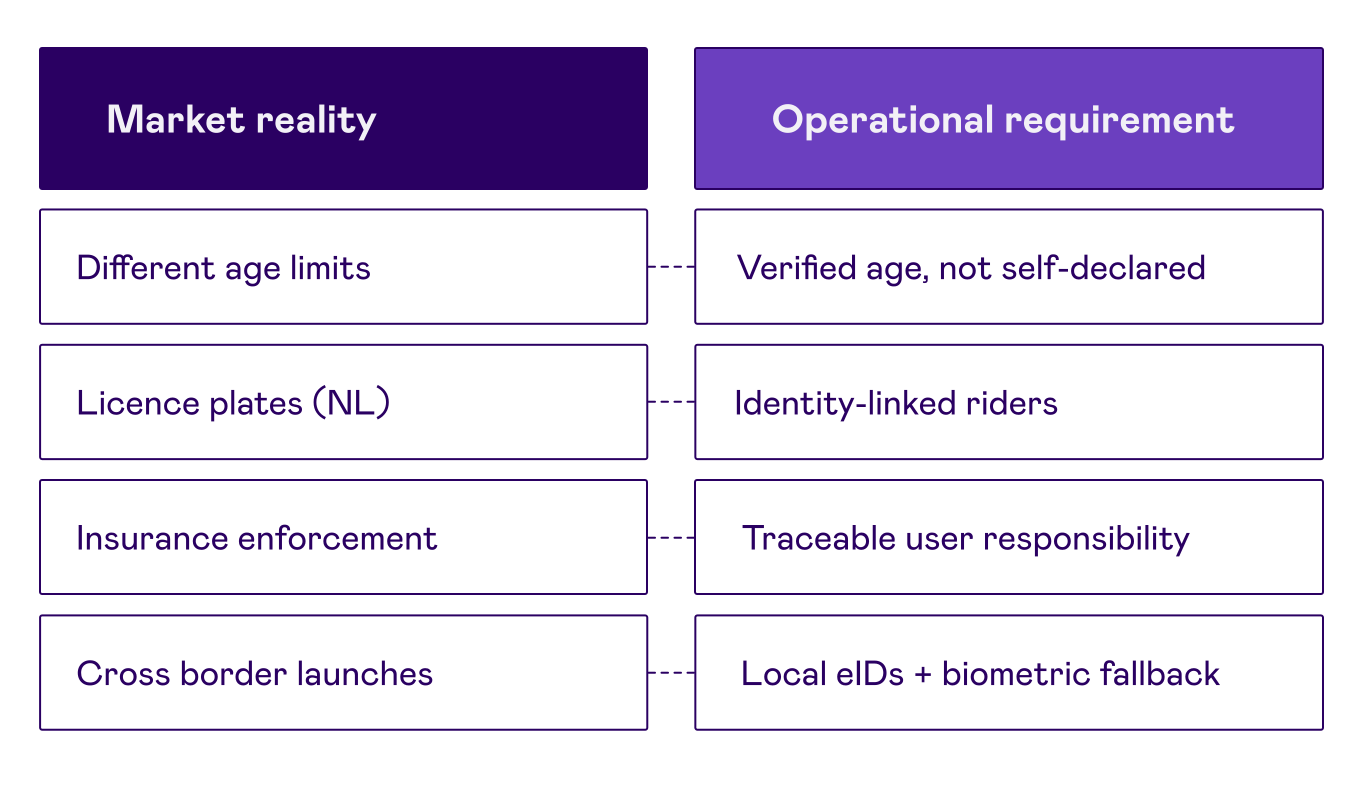
Only identity that is robust, verified and repeatable scales across markets. Only identity can turn fragmented legislation into a unified trust strategy.
This is where operators are increasingly separating themselves. Not by adding more friction, but by building an identity layer that can match local requirements market by market, provide auditable proof when cities, regulators or insurers ask for it, and reduce fraud without destroying conversion.
Working with a provider that already connects to Europe’s leading eIDs, and can add biometric verification where there is no strong local credential, removes a huge amount of operational drag. It is the difference between reacting to regulation and being ready for it.
Looking ahead to 2026: Harmonisation or enforcement?
There is ongoing discussion in Brussels about harmonising aspects of personal mobility. Even if Europe moves towards harmonisation on paper, enforcement will remain local. City contracts, permit renewals and police enforcement will still be shaped by local priorities.
Operators will not succeed by waiting for uniformity. They will succeed by building systems that can adapt country by country, city by city.
And that adaptability starts with identity.
Conclusion: Compliance will define scale
By 2026, the question facing micromobility platforms will no longer be “How fast can we grow?” It will be “How credible are we in the eyes of cities, insurers, and regulators?”
Fleets can be copied. Prices can be matched. But trust, proven through identity, is now a competitive advantage.
Identity is the only constant in Europe’s fragmented rulebook. The operators who understand this will be the operators still scaling in 2026.
If you are building for that future, it is worth treating identity as core infrastructure, not an onboarding checkbox. A European identity partner such as Signicat can help you combine local eIDs, document and biometric verification, and risk-based step-up checks into one consistent approach across markets.